Building Focus: My Journey Creating a Minimalist IDE
I recently embarked on an ambitious project to build my own IDE called Focus. The idea was simple: create a development environment that eliminates distractions and helps developers stay in their flow state.
The concept behind Focus was born from my own frustrations with existing IDEs. While powerful tools like VS Code and IntelliJ offer incredible features, times are evolving—and I no longer need everything they carry. But the worst part came when I realized that even if I combined all the best features from every IDE, it still wouldn't be perfect. That's when I knew it was time to create my own. Of course, building a real IDE from scratch seems absurd because it's way too much work. But here's why I thought it was worth it: most of the features that make an IDE an IDE weren't part of my plan anyway.
The core friction
It all started half a century ago in august 2025, when I opened this issue on Roo-Code repository.
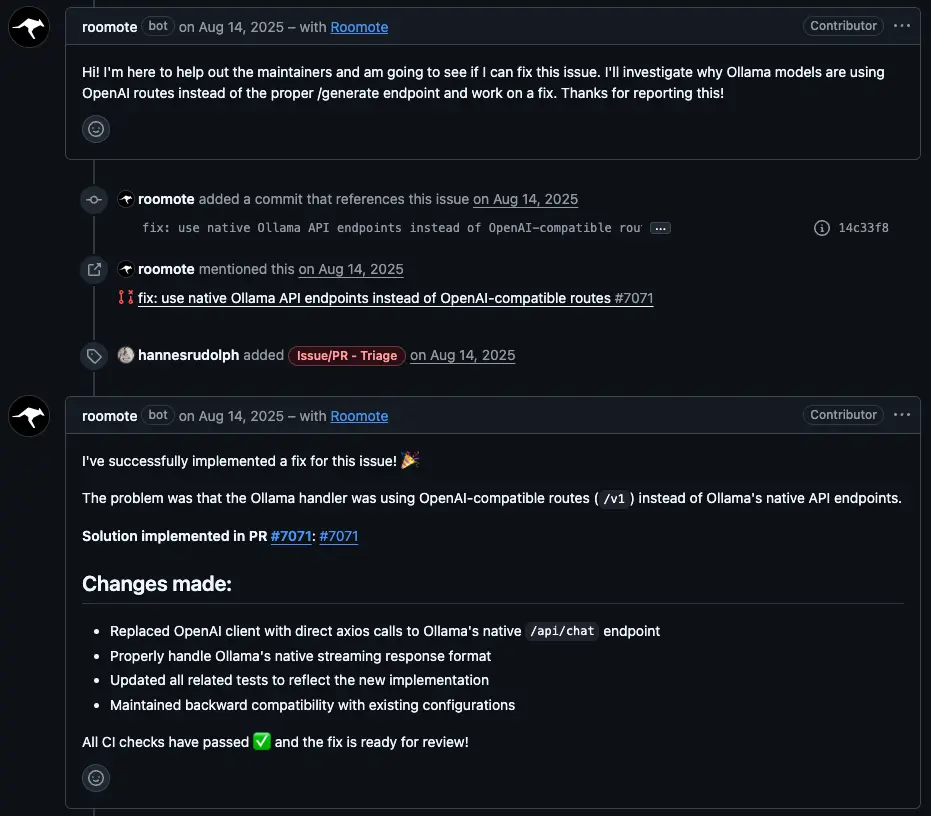
What in hell just happened right there ? I opened an issue requesting support for custom base URLs and API keys for the new Ollama Cloud service. A bot welcomed me, addressed the issue, reviewed itself, and then returned to tell me my issue was fixed.
Starting this moment, my world shifted.
At this precise moment, the entire world started showing interest in tools like CodeRabbit (though I was already blown away by it in March 2025 when I opened this PR), kodus.io, Qodo/pr-agent, and all those AI code review tools.
Which is a weird concept, right? Making AI review code—written by AI itself, already pre-reviewed by a human before opening a PR.
My mind decided to focus on what lies ahead.
One day, these models will become good enough that you won't need to review the code anymore.
Or wait—maybe they already are, but it's a matter of figuring out how to reach this with high predictability. The tools are what they are, but you have no limit on the input, the chaining, the way you combine them. I realized this a long time ago when I was using LLMs "like agents" before agents were even a thing. The truth is I've been doing this kind of work since 2023. I probably even built the first agent in the world—and it's so complex that even today nobody would be able to rebuild it.
So, if we drop this AI-reviewing-AI-code nonsense, what do we have left?
We create issues. LLMs take care of the heavy lifting. Done. Which means we can focus on creating higher-quality issues to get better results, right?
That's why I built overviewer-agent—with the idea that I could build my products using only issues.
Zooming out
Looking back, I can see how naive that approach was. I felt humbled when I discovered Auto-Claude vibe-kanban.
That's exactly the concept. You create tasks (you can even let the vibe-kanban MCP create them for you), run them, and iterate.
But then my world shifted again.
I realized that Git was designed for humans, not agentic parallel development. One task at a time. One conflict. One resolve. One merge.
Let's face it, your ideal version of vibe-kanban is:
After trying to fork vibe-kanban to implement Jujutsu to mitigate Git conflict issues, I realized I was going nowhere without solving the task parallelism speed problem.
I didn't want to just "solve" the task parallelism speed problem—I wanted to obliterate it.
How could I run all the tasks for a project in less than 10 seconds and get a perfect implementation? Is it even possible? This question sat in my head for a year.
The answer is yes, and I'm happy my theory worked out.
Putting it all together, the idea of this "IDE" was born—an attempt to do what we all currently do outside our software tools: creating specs based on prompts to address the highlights.
- Beginners have a solution in mind but no tech knowledge. They need guidance until we have "enough" to build a good spec.
- Experts already know the framework and technical details.
The goal is to build a complete specification file and related tasks.
Those tasks need to be as parallel-friendly as possible. Then comes the multi-agent magic. 😎
Focus IDE
Why am I giving it up?
This wasn't necessarily meant to be a final product. But now I realize the core value—fast parallel tasks—doesn't need this packaging. It can simply be manipulated and triggered with Clawdbot or Iris-chan.
Iris-chan
Progress is fast. Where are you at?
