Arrogance vs. Survival

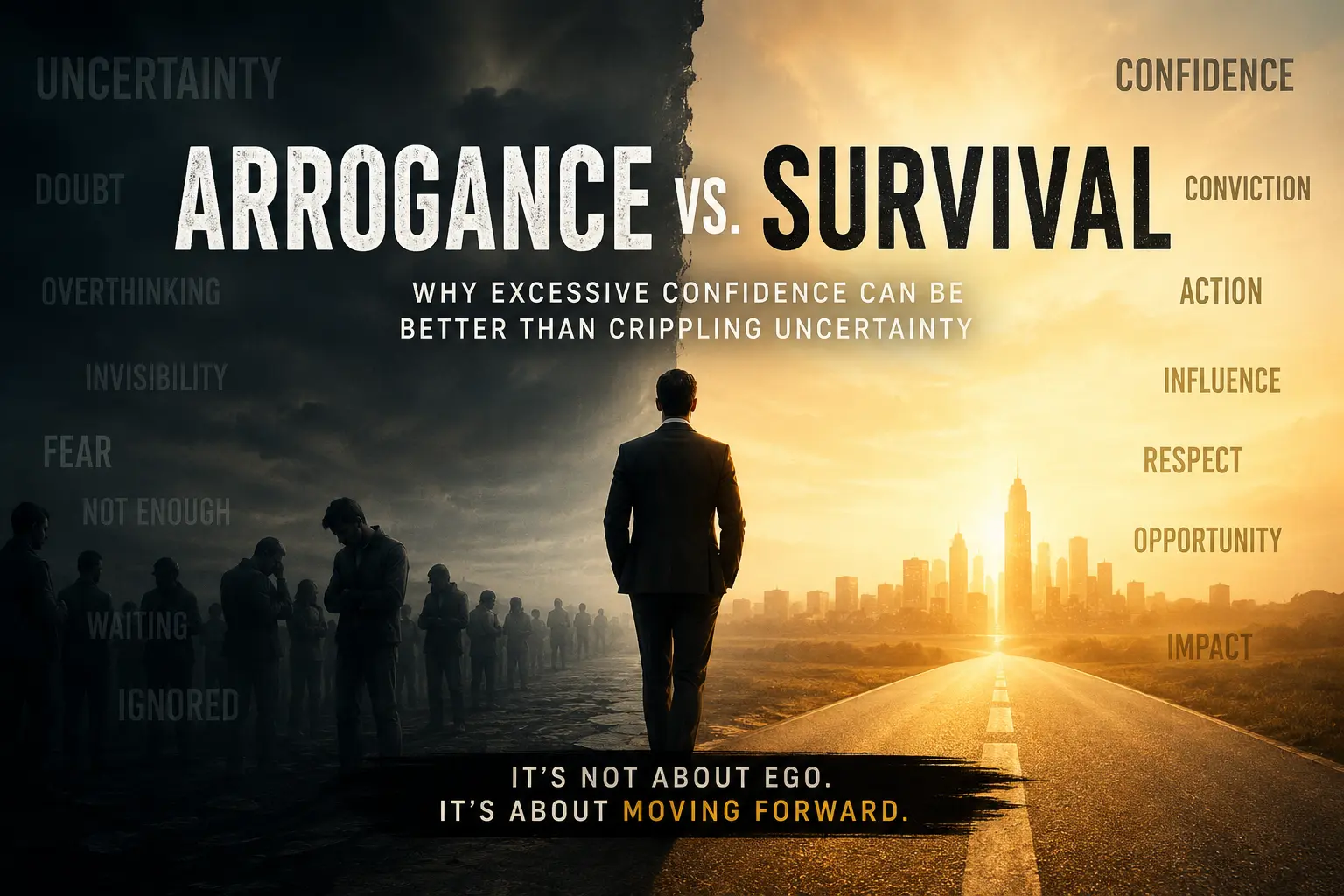
Why I think arrogance is often a symptom, not a personality trait.
Arrogance has one of the worst reputations in modern culture.
We’re taught to be humble. To stay open-minded. To listen. To doubt ourselves. To avoid sounding too confident.
And generally speaking, that’s good advice.
But there is a problem nobody likes to talk about:
Uncertainty can destroy your life far more effectively than arrogance ever will.
I’m not arguing that arrogance is a virtue.
I’m arguing that, when forced to choose between chronic self-doubt and excessive confidence, excessive confidence is often the less destructive option.
Because at least it moves.
The ideal doesn’t always exist
The ideal mindset is obvious.
Confidence without arrogance.
Humility without insecurity.
Conviction without ego.
Unfortunately, reality rarely gives us perfect options.
Many people spend years trapped in uncertainty.
They second-guess every decision.
They wait for more validation.
More experience.
More permission.
More certainty.
The result?
Nothing happens.
The arrogant person launches.
The uncertain person keeps preparing.
The arrogant person gets criticized.
The uncertain person often gets ignored.
One of them at least creates opportunities.
The other usually creates nothing.
The market rewards confidence before correctness
This is uncomfortable, but it happens everywhere.
Investors back founders who believe.
Customers buy from people who sound convinced.
Employees follow leaders who appear certain.
Audiences listen to speakers who communicate with conviction.
That doesn’t mean they’re always right.
It simply means confidence is persuasive.
Meanwhile, someone with twice the competence but half the confidence often struggles to be heard.
Reality is unfair in that sense.
People don’t evaluate ideas in a vacuum.
They evaluate the confidence of the person presenting them.
I don’t think arrogance is usually the cause
Here’s the part that changed my perspective.
I don’t believe arrogance is always a natural personality trait.
I think, in many cases, it’s a response.
A defense mechanism.
A compensation.
When someone repeatedly feels underestimated…
Ignored…
Dismissed…
Disrespected…
Eventually they stop asking for permission.
They stop trying to convince everyone politely.
Instead, they project certainty.
Sometimes excessively.
From the outside, it looks like ego.
From the inside, it may simply feel like survival.
Recognition changes people
Imagine two equally talented people.
The first grows up surrounded by people who recognize their abilities.
Teachers encourage them.
Managers trust them.
Friends value their opinions.
They don’t need to fight for credibility.
Now imagine someone equally capable but constantly overlooked.
Every idea is questioned.
Every achievement minimized.
Every success attributed to luck.
Eventually, they become louder.
More forceful.
More confrontational.
Not necessarily because they think they’re superior.
But because experience taught them that speaking softly wasn’t enough.
Whether that reaction is healthy is another question.
But it’s understandable.
There is one thing I find fascinating about arrogance
One observation keeps coming back to me.
Arrogance is surprisingly difficult to fake.
People fake humility all the time.
They fake confidence.
They fake kindness.
They fake expertise.
They fake authenticity.
But genuine arrogance is different.
Someone who constantly exaggerates themselves while secretly doubting everything usually doesn’t convince anyone for long.
Real arrogance tends to come from genuine conviction—whether that conviction is justified or not.
That’s what makes it interesting.
It’s often an honest expression of what someone truly believes about themselves.
Honesty doesn’t automatically make it admirable.
But it does make it revealing.
The four outcomes
If you simplify things, there are roughly four possibilities.
1. You’re highly confident, and your ability matches your confidence.
People may find you difficult.
They may even dislike your personality.
But over time, results usually speak loudly enough that respect follows.
2. You’re highly confident, but your competence doesn’t match it.
This is the dangerous version.
Confidence without substance eventually collapses.
Reality catches up.
Arrogance becomes comedy.
We’ve all met this person.
And everyone notices the difference.
3. You’re capable, but constantly uncertain.
This might be the most tragic scenario.
Because your ideas never reach the people who need them.
Not because they’re bad.
Because they were never defended strongly enough.
History probably contains countless invisible geniuses whose greatest mistake wasn’t lack of intelligence.
It was believing that good work would naturally speak for itself.
Often, it doesn’t.
4. People naturally recognize your value.
This is the lucky path.
You don’t need to prove yourself constantly.
You don’t need armor.
You don’t need arrogance.
The environment gives you legitimacy before you ask for it.
Not everyone receives that gift.
Maybe arrogance is armor
What if arrogance isn’t the disease?
What if, sometimes, it’s the scar tissue?
Not every arrogant person is protecting themselves.
Some are simply narcissistic.
Some genuinely believe they’re above everyone else.
But others may simply have spent too many years having to justify their existence.
If everyone consistently respected competence fairly…
If recognition was distributed according to merit…
If people were judged primarily by results…
Would arrogance become less common?
I suspect it would.
Because people don’t usually build armor when they feel safe.
The uncomfortable truth
Society often says:
“Be humble.”
But the world frequently rewards something different.
It rewards visibility.
Certainty.
Presence.
Narrative.
The loud are heard before the wise.
That isn’t how things should work.
But pretending otherwise doesn’t change reality.
My conclusion
I’m still convinced that arrogance isn’t the ideal.
The ideal is confidence grounded in competence, combined with enough humility to keep learning.
But if someone is trapped between two extremes—crippling uncertainty or excessive confidence—I believe excessive confidence is often the more survivable state.
Not because it’s morally superior.
Because it creates motion.
Because it allows action.
Because it gives ideas a chance to exist in the world.
The goal isn’t to become arrogant.
The goal is to become so competent, and so respected, that arrogance is no longer necessary.
Until then, some people wear it like armor.
Not because they enjoy wearing it.
Because, in their experience, walking into battle without it was worse.
But none of everything in this article is the reason why I am arrogant. I am arrogant just because I am a fucking asshole and it's free.
Cheers 🍺