
This month I got three refunds I never knew I had asked for.
Cloudflare credited $5 on an invoice I'd forgotten. Fly.io voided a $5.27 charge from an app I hadn't touched in years. The third one, I'm keeping for the end.
I didn't write any of those emails. A bot did. And the funniest part: Cloudflare's reply ended with "This reply was enhanced by Cloudflare Workers AI."
My bot wrote the request, I just said yes. Their bot wrote the answer.
Workers Paid plan · billed 4 Nov 2026
My bot
Please cancel my subscription and, if you can, waive the outstanding fees and any late penalties.
Cloudflare
I've submitted a one-time credit of $5.00 for that invoice.
This reply was enhanced by Cloudflare Workers AI.
October usage · invoiced 1 Nov 2026
My bot
I haven't used the platform in nearly three years. Could you cancel these fees as a goodwill gesture?
Fly.io
I've already voided the $5.27 invoice. Our prices went up in October and pushed your bill over the $5 waiver.
If I’d had to do this by hand, I never would have done it.
If you're still opening a coding agent, typing a prompt, watching it work, and typing the next prompt, you're not using AI. You're babysitting it.
Claude Code, Codex, Cursor, every shiny ADE that wraps them in a nicer window: they're all the same shape. You are the scheduler. You are the memory. You are the one who notices that something needs doing in the first place.
That shape is already outdated.
What proactive actually means
A proactive agent doesn't wait for your prompt. It has a job, and it shows up for it.
- It wakes up on its own. On a schedule, a webhook, a GitHub event, or a change it's watching.
- It remembers. What it learned last week is still there this week, and it shares it with the rest of the team.
- It hands off. Bots delegate to each other instead of everything going back through you.
- It owns an outcome, not a conversation.
Your goal isn't to control your terminal anymore. It's to control your agents.
What I found in Rakazo
The tool I landed on is Rakazo: an open source alternative to Grok Bot. Free to self-host, Apache-2.0, your keys, your model, your machine. It deploys on any VPS with one install script.
My setup, if you want to copy it:
Show my Docker setup docker-compose.override.yml · anonymized
# 1. Upstream stack, unmodified (v0.15.0): docker-compose.images.yml
# 2. My override: puts the web app behind Traefik with HTTPS
# 3. Run:
#    docker compose --env-file .env -f docker-compose.images.yml -f docker-compose.override.yml up -d

# Public route: Traefik (proxy network) -> rakazo-edge:5173 -> web:5173.
# A tiny TCP relay instead of attaching `web` itself to the proxy network: on a shared proxy
# network other apps may also answer to the name "web", so the relay targets the unique
# container name rakazo-web-1 (project name "rakazo" + service "web" + index 1).
#
# Compose loads this file automatically next to docker-compose.images.yml, or pass both:
#   docker compose --env-file .env -f docker-compose.images.yml -f docker-compose.override.yml up -d
services:
  rakazo-edge:
    image: alpine/socat:1.8.0.1
    restart: unless-stopped
    command: ["TCP-LISTEN:5173,fork,reuseaddr", "TCP:rakazo-web-1:5173"]
    read_only: true
    init: true
    security_opt:
      - no-new-privileges:true
    cap_drop:
      - ALL
    pids_limit: 256
    mem_limit: 64m
    networks:
      - app
      - proxy
    depends_on:
      - web
    # Optional: if your Traefik uses the Docker provider instead of a file route (traefik-rakazo.yml),
    # uncomment these labels and drop the file route.
    # labels:
    #   - traefik.enable=true
    #   - traefik.docker.network=${PROXY_NETWORK:-proxy}
    #   - traefik.http.routers.rakazo.rule=Host(`rakazo.example.com`)
    #   - traefik.http.routers.rakazo.entrypoints=websecure
    #   - traefik.http.routers.rakazo.tls.certresolver=letsencrypt
    #   - traefik.http.services.rakazo.loadbalancer.server.port=5173

networks:
  # The external network your reverse proxy (Traefik) sits on.
  # On Dokploy this is "dokploy-network".
  proxy:
    external: true
name: ${PROXY_NETWORK:-proxy}And if you're building your own remote control for agents right now: don't. It's built in, on web, desktop and phone.
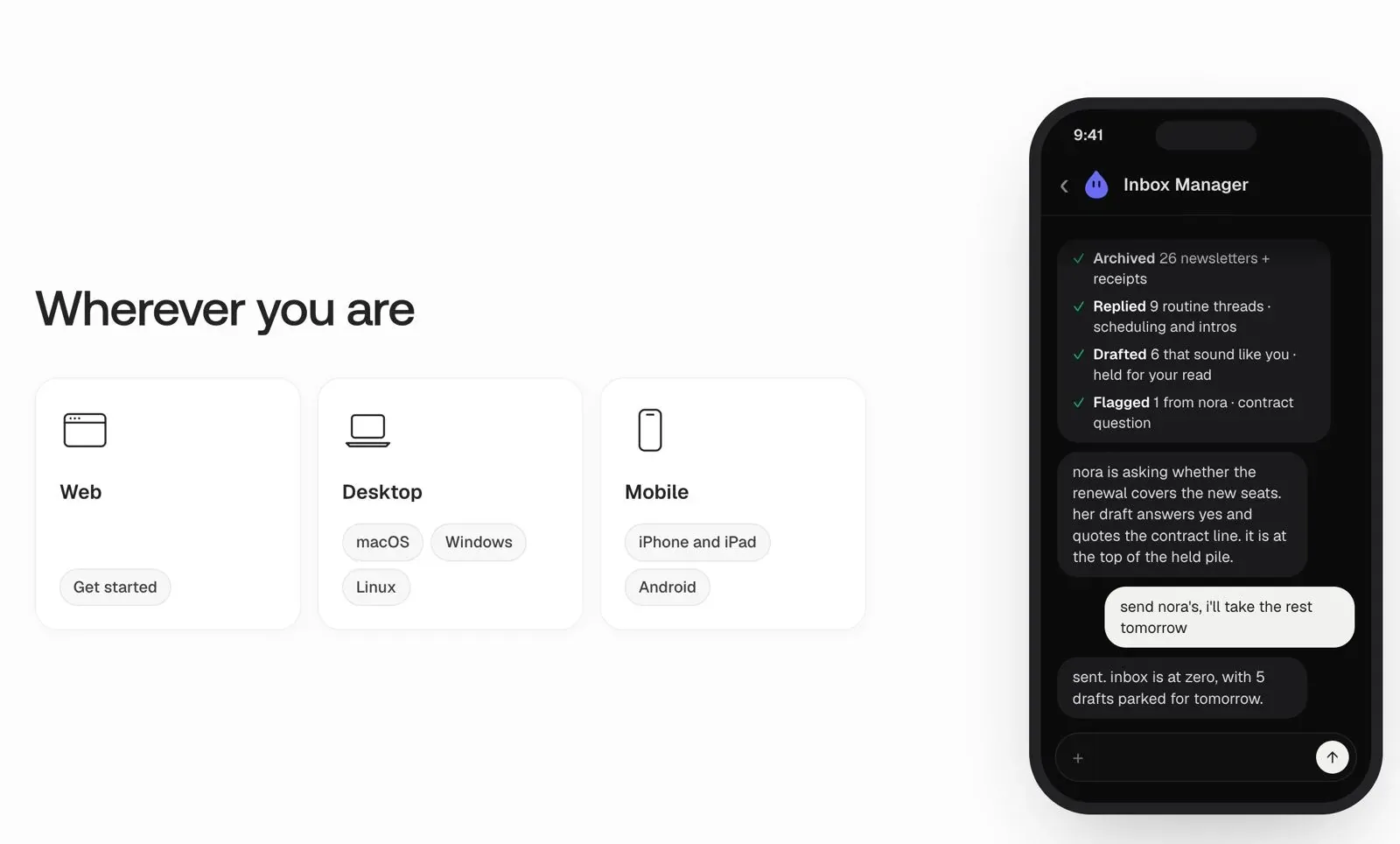
The marketplace isn't empty either. Rakazo reads the plugin registries that Cursor and xAI already maintain, so nearly 200 plugins show up on day one: Supabase, Stripe, Sentry, Gmail. You click Add, sign in, done.
I tried to be smarter than everyone
My first move was to fork it and wire in Pi Durable, convinced I'd make it better. Then a plugin install asked me: "Rakazo plugin or Pi plugin?"
That's when I felt stupid. Rakazo already had bots that start on their own, and my fork had switched off its tools, approvals and computer use. I reverted.
And I understood why Grok Bot and its clones hook people so fast. You don't manage dumb agents: you get a team of coworkers that act on their own, message each other and hand work off.
Pi Durable didn't go to waste. I use it for engineering work, and I turned it into a tutorial: The Life of Pi Durable.

It looks like what everyone tried before. It isn't.
Look at that phone screenshot and you'd think: a chat with a bunch of bots, people have built that since AutoGPT. I thought so too.
But everyone who tried before, me included, spent their time compensating. The agent crashes and the work is gone. A restart loses whatever was in flight. Pi Durable fixes that core: it saves every model turn and tool call first, so a crashed agent resumes where it stopped.
Before that, I spent months building my own Jarvis, called Iris. One brain for everything: my email, my 45 websites, my reasoning. Too much for a single entity. That's a job for a team.
But as I wrote in Your Shitty Team Of Specialized Agents, agents that wait for you to orchestrate them are just more tabs. The missing piece was proactivity.
Rakazo vs Grok Bot vs Linger
Before committing, I had the three serious options audited side by side, code included: Rakazo, Grok Bot, and Linger, the open source personal agent that runs fully on your own computer. Linger comes from Simplex AI, founded by Bo Zhang, a former AI scientist at DeepSeek.
| Capability | Rakazo | Grok Bot | Linger |
|---|---|---|---|
| Self-hosted, open source, your data | ✅ | ❌ closed, cloud-first, paid | ✅ modified Apache-2.0 |
| Any model, your own keys | ✅ | ❌ you can't pick the model | ✅ Claude Code, Codex, Pi, local models |
| Event triggers (email, webhook, git) | ✅ native | ✅ plus PagerDuty and Sentry | ⚠️ polls every 10 min, no webhooks |
| Approval gates | ✅ ask / auto / never, spending limits | ✅ plus a human hand-off for passkeys | ✅ rule checks, plus an AI judge on every action |
| Isolated bot computer | ✅ Docker, E2B, Daytona… | ✅ one shared cloud VM | ❌ runs directly on your machine |
Grok Bot is the most polished, but it fails the one test I won't compromise on: I own the agents, the keys and the data. Linger has great ideas (its wiki-style memory and its AI judge for risky commands are worth stealing) but it's an early preview running straight on your machine. Rakazo is the only one that's open, self-hosted, isolated and already mature.
Full disclosure: I never tried Grok Bot myself. It needs a Cursor account, and I don't have one. A friend who does was waiting for his usage quota to reset when I asked him about it. A proactive system with a quota? No thanks.
On Rakazo, you plug in the subscriptions you already pay for (Claude, ChatGPT and Codex, GitHub Copilot, SuperGrok) or run local models.
The team
Today I run 17 agents, spread across several machines, including my sister's computer. One entry point, the rest organizes itself.
| Agent | Its job |
|---|---|
| Chief of Staff | My single entry point. Plans, delegates to the others, reports back. |
| Sentinel | Watches blogs, dependencies and servers for updates and vulnerabilities. Asks before fixing. |
| Reviewer | Reviews PRs locally with my own review workflow. Zero CI cost. |
| Negotiator | Drafts honest requests for refunds, credits and discounts. Nothing leaves without my go. |
| Forge | Creates a new agent from one sentence: code, tests, PR. Every write needs my approval. |
| Accountability | Answers "has X actually been done?" with evidence: done, not done, blocked or unknown. |
| Critical Thinker | Reads my conversations and challenges weak reasoning or false certainty. I can't summon it. |
| Scout | Finds products that match my criteria (MCP, CLI or API mandatory) and returns one pick, with sources. |
| Model Radar | Tracks AI models: price, speed, time to first token. |
| Ledger | Reads my expenses and tells me what to pay next. Never pays. |
| Inbox Curator | Learns what I keep and suggests batches to archive. |
| Navigator | Drives my real browser and Mac apps, only on request. |
| Job Hunter | Looks for jobs and missions that fit me. |
| Asset Librarian | Keeps my images, logos and files findable. |
| PR Helper | Helps my pull requests get through review and merged. |
| Sign-in Concierge | Clicks the useless "Continue" after a Gmail, Claude or OpenAI sign-in, so I never have to. |
| Social Twin | Trains me to answer in my own style. Never sends anything. |
Sentinel exists because this very blog got hacked: I was still on Ghost 5 instead of 6. With 30 to 45 apps in production, nobody can watch every release by hand. Now it patches what needs patching, and asks before touching anything risky.
I didn't build them because I'm smart
I don't have 17 agents because I spent months designing an architecture.
I spent one week dropping every single thing that pissed me off into the Chief of Staff. That's how they were built.
Down to the tiniest detail. I don't want to click the stupid "Continue" button after a Gmail, Claude or OpenAI sign-in ever again. It's useless. Boom: that's a bot.
Annoyance in, agent out. That's the whole method.
If bots decide, ask everyone
Back to the refunds.
The Negotiator asks systematically. Whether I'm right or wrong. Even when they have no obligation to refund me. Why not? What does it cost me? I don't even have to do it.
And when the other side is a bot too, the answer is often yes. Not asking is the only way to guarantee a no.
That's the point most people miss. Proactive agents don't just save you time on things you were already doing.
They make a whole category of things worth doing that you never would have bothered with.
Bonus: the third refund
I found it by surprise: $1,349.98 back on my bank account.
It was a Visor headset I pre-ordered in May 2024 and never got. I thought it was too late. My Negotiator didn't: it had spotted signs that Visor would go bankrupt within 3 months, and asked for my money back before it was gone.
Back on my account
$1,349.98
- I pre-order a Visor headset. It never ships.
- My Negotiator spots signs Visor will go bankrupt within 3 months and asks for a refund.
- Visor confirms. The money lands back on my account.
I was really happy. Agents usually cost you money. This one brought it back.
Rakazo is free and open source: rakazo.com · github.com/elie222/rakazo. Deploy it on your own VPS this afternoon.
Then stop prompting. Start delegating.
What about you? Which one are you going to choose and why Rakazo?